INHALTSVERZEICHNIS
abaton x EU LIFE = LIFEabatoncircular
EU LIFE supports decarbonization, automation, and the use of secondary raw materials
CO₂-neutral cooling, heating & acoustics - co-funded by EU LIFE
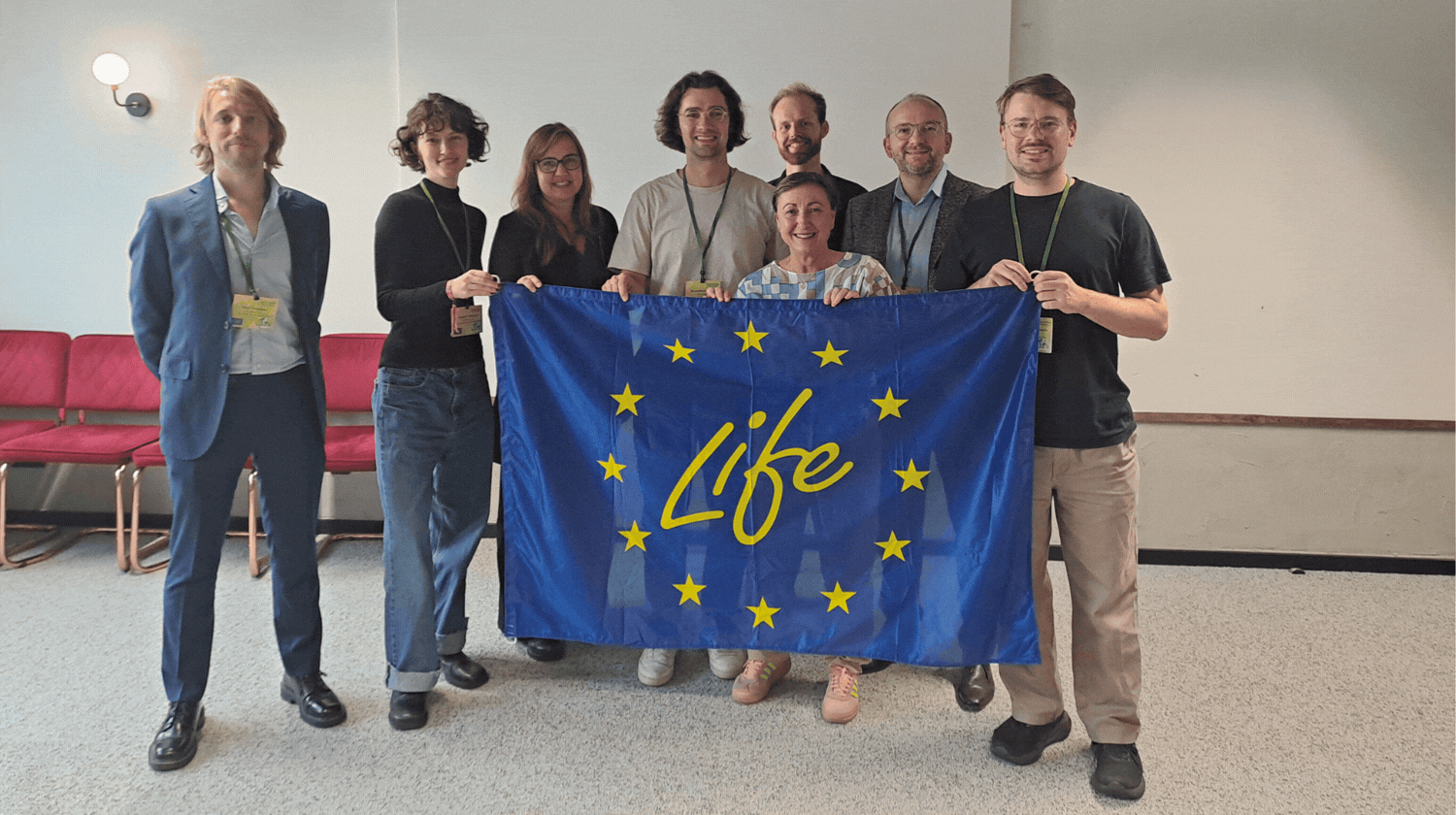
In July 2025, with support from the EU LIFE Programme, abaton launched a three-year research and development project.
Under the name “LIFE abatoncircular,” the project is one of 132 projects selected under the EU LIFE 2024 call from nearly 900 applications.
- Project title:
LIFE abatoncircular – Demonstration of the Automated, CO₂ Neutral & Circular Production of Radiant Heating and Cooling Panels with Humidity Control from Recycled Inputs - Project duration:
01/07/2025 – 30/06/2028 (36 months)
INHALTSVERZEICHNIS
Our mission: Make sustainability the standard
The abaton panel will be produced CO₂-neutrally from recycled concrete rubble.
Thanks to a proprietary pore structure, abaton acoustic, heating, and cooling panels actively regulate humidity. During operation, this can save around 30% energy per year on average. The biggest energy driver in radiant cooling is dehumidifying indoor air to prevent condensation. abaton ceiling systems do not require this additional system and can cool reliably and fault-free even with a reduced ventilation system—or even without mechanical ventilation, with an open window.
For us, sustainability means more than reducing operational energy consumption. Our ambition is also to tackle embodied emissions and the use of virgin primary resources. The goal of the project is to develop an automated, CO₂-neutral, circular production process that makes recycled concrete rubble usable for our panels.
The goals of LIFE abatoncircular
Our goal: Reduce embodied emissions to zero and lower the use of virgin primary resources.
- Secondary raw material resource:
Concrete rubble that is currently mostly landfilled will be upgraded into a high-quality secondary raw material and used as the feedstock for abaton panels for cooling, heating, and acoustics. - Circularity:
End-of-life is considered from the outset. The panels are designed so they can be fully recycled after use and returned to the material loop. - CO₂-neutral production:
Manufacturing with recycled concrete rubble binds more CO₂ than it causes. This enables fully CO₂-neutral production of abaton panels. - Semi-automated production process for scaling:
To achieve economic and ecological impact, a semi-automated production facility is planned. After successful demonstration of the automated manufacturing process, the product and production technology will be licensed to precast plants across the EU to make abaton panels widely available at a competitive price.
The project is forward-looking because the construction sector is not only one of the largest CO₂ emitters, but also the largest generator of waste in the EU.
Ongoing climate change = rising cooling demand
Ongoing climate change and the associated rising temperatures will significantly increase the need for building cooling in Europe over the coming decades.
According to the EU climate service Copernicus, the summer of 2025 was the fourth-warmest ever measured on the continent: the average temperature was 0.90°C above the 1991–2020 average, only 0.65°C below the record year 2024 (1.55°C) and just 0.07°C below the third-warmest summer in 2021. The trend is clear and shows a steady increase in extreme summer heat.
In addition, urbanization and demographic ageing intensify cooling demand, as more people live in densely built environments and the share of heat-sensitive population groups grows. Forecasts suggest that energy demand for space cooling in the EU will rise by 200–600% by 2050 (Andreou et al., 2020). Cooling is therefore becoming one of the central obstacles to achieving the EU’s climate targets in the building sector.
“Growing demand for air conditioners is one of the most critical blind spots in today’s energy debate. Setting higher efficiency standards for cooling is one of the easiest steps governments can take to reduce the need for new power plants, cut emissions and reduce costs at the same time.”
— Fatih Birol, IEA Executive Director
The current market standard for building cooling is not fit for the future: conventional air conditioning is energy-intensive and environmentally harmful. While chilled ceilings are a more efficient alternative, they are limited in humidity control and require additional ventilation systems for dehumidification.
There is therefore a clear need for energy-efficient forms of building cooling such as the abaton panel, which offers high comfort without placing additional strain on energy infrastructure, power grids, or the environment.
In our view, future-proof building technology must not focus only on operation, but must consider the entire life cycle of the components and materials used.
Circularity as a key to a future-proof European construction sector
The construction industry is among the most resource- and waste-intensive sectors in the EU.
It generates around one third of total waste volumes and contributes significantly to CO₂ emissions and raw-material consumption. At the same time, a large share of circular potential remains unused: currently, only about 40% of construction and demolition waste is recycled or reused, while the rest is landfilled or used for energy recovery.
With the Circular Economy Action Plan, the EU set the course in 2020 and defined construction as a key sector for achieving resource and environmental goals. In the future, buildings must therefore be planned to be durable, flexible, and reusable.
Our EU LIFE project makes a substantial contribution to this transition by using recycled concrete rubble as a secondary raw material and returning materials to the loop at end of life.
Updates on LIFE abatoncircular
Join us on the path to real impact
We will report on the progress of LIFE abatoncircular in our monthly newsletter.